Wednesday, May 1, 2013

Oblivion Review


Sometimes, the fact that I have seen so many movies lessens the experience of watching certain films. Oblivion, staring Tome Cruise, is one such film. There are spoilers throughout this review, so just be aware. 

Oblivion has many facets that feel like bits and pieces taken from other science fiction films that came before it. 2001, The Matrix, Terminator, Wall.E, Moon, Star Trek/Borg and even the 1980s cartoon, Thundarr the Barbarian. Having aspects or elements in any story that are reminiscent, gleaned, borrowed, homaged, or otherwise ripped off from someplace else is nothing new. All of the aforementioned obvious sources were themselves borrowing from earlier stories. Even the great Stanley Kubrick himself never wrote original work, but would always use source material as the jumping-off point for a fresh, new take on an already seemingly overdone topic; ie, war, horror, sci-fi, etc. So yes, Oblivion is not entirely original. The film did suffer from feeling too cobbled together form various sources. But more importantly, was it any good? From my perspective as a science fiction loving geek/nerd...yes. It certainly could have been better. It was not perfection, but it did have aspects of it I enjoyed greatly and it lacked some of the more typical and often overused elements in science fiction films—which is a good thing. First, there were no slimy aliens running around trying to eat humans. Second, there were no giant space battles. Third, there were no crazed, dark antagonists hell bent on chaos and destruction. Sci-fi films are overrun by those elements, and I was happy to see none of them present in this movie.

The film was often quiet and took its time. I liked that too. Many science fiction films never sit still and just feel panic-stricken. There were a few too many chases and action scenes tossed in that I could have done without, but not too many that it caused the film to drag. Even the film’s end, with the flashback/climax, managed to steer clear of the typical Michael Bay SFX computer-generated fructose tsunami that usually ends many a sci-fi film. 

The trailer is partially to blame, leaving some of the spontaneity missing from the film. I knew that there were no flesh and blood aliens and that is was a group of humans led by Morgan Freeman. I also knew there was a robot/AI/whatever behind what was going on. The trailer could have helped this some by not showing the underground humans at all. Too much was revealed, to me, before I even saw the film. The reveal in science fiction has become more important than the film itself. Oblivion definitely contains a substantial reveal, it does not rely too heavily on it.

Ultimately, I came away having enjoyed the film. It has rewatchability, and that is more than many films these days can say. I'd never sit through Looper again. It was also stunningly beautiful, and cinematography is a category in cinema that is often overlooked. Just being able to sit back and gorge one’s eyes and mind on beautiful photography, accompanied by a great score, seems absent from what is expected from films these days. I think Terrence Malick's Tree of Life woke up many filmmakers, and I am beginning to see traces of it in other films. Oblivion, Prometheus, and even the upcoming After Earth seem to take note of the importance of great cinematography in a film. SFX junk is just a tool, and all the explosions and space battles in the world will not make a film any better. But something that is gorgeous in and of itself, even if you were deaf or did not know English, still has vast merit. Oblivion scores high here. The music was great too. I noticed it, which is more than I can say for 98% of what I see these days. Years ago I used to fall in love with so many films scores. Today film music is rarely even worth a one-sentence blurb. Music is very important in a film. Great music can aid a film tremendously. Why this is overlooked more and more and just slapped on is a mystery to me. Films take humanity’s great artistic achievements and incorporate them all together. When done well, the end is greater than the sum of the parts. Blade Runner is a prime example of great music accompaniment. Without the Vangelis music, Blade Runner would not be the same. The music in Oblivion fit the film and had me considering picking up the score—a rarity these days. 

There were aspects of the film I did not like and/or was also unclear about. The clone thing was not needed, and was already done recently in Moon. The opening voiceover was not needed. It felt added on. Show me, don't tell me. It just felt a bit like misguided filmmaking to me.

The iconic New York locations were lame. It looked cool, but seriously, what are the odds that the film’s protagonist, a diamond-in-the-rough of clones, would also be located near the most famous city ever? Sci-fi needs to steer clear of big cities from now on. 

Couldn't the drones have other drones to fix themselves? 

Sally/Tet was revealed as so powerful that the number of drones seemed inadequate compared to amount it could have produced. 

I was unclear why an army of M/F clones were needed. An army of drones to kill all the humans would seem to me to be more efficient. Maybe this was unanswered on purpose. 

Was Sally/Tet an alien originated AI, or was it of human origin? I guess it's OK that this is unanswered, or if it is answered I missed it the first time around. The sucking up water thing was lame. Water is made of two relatively common elements, hydrogen being especially common. No advanced anything would need it, nor travel here for it. A more real, well-thought-out purpose was needed for the Borg/AI in this film. If the AI was of human origin, then the water thing needed more explanation. The idea of having the AI of human origin and created for a goal humanity set out is interesting. It carrying out some earlier order to collect water to be taken elsewhere by humans is interesting. If the AI went nuts and killed humanity, and continued blindly drying out earth for an old standing directive, well, that is cool too. Either I missed something, or perhaps—and I hope this is the case—that the film was intentionally left open-ended enough for my theory to find a home. When everything is explained perfectly, then only that explanation is what you will come away with. When a film is slightly open-ended, then the sky’s the limit. 

For me, Oblivion was a strong 6 out of 10. The SFX, music, acting, and photography were strong and helped the film become something beautiful that need not be enjoyed or disliked on the strength of the writing alone. And that’s a good thing, because the writing was lacking. A slightly better screenplay could have aided this film a lot. I do want to see it again, so it’s possible that some of my questions might be answered. It was still one of the stronger non-comic book science fiction films to come along in a while. 

Tuesday, April 16, 2013

Repo Man (Criterion Collection) [Blu-ray] Review

Outer cover
So it turns out the fringe cult film that helped define my 14+ onward youth is now getting the recognition it deserves. I can't help but think, too, of A Clockwork Orange, which I also discovered as a kid and worshipped as well. As I grew older and acquired some semblance of a brain, I realized that there was more going on in both films than just apathetic youth stumbling around causing truble.

Repo Man was, first and foremost, completely hilarious. Its irreverence for everything and everyone, particularly authority, was what drew me to it in the first place. When I watch the film I am reminded of going out skating in the parking lot of a dry cleaners after hours, as well as aimlessly roaming around with my friends. Aimlessly. That pretty much sums it up. I may not have been able to put my finger on what it was about the film back then that made it great, but complex, pseudo-intellectual explanations were not high on my list as a kid. It was just a "great film" or "funny as hell" and above all, extremely quotable. Quoting films has pretty much caught on as a sort of sub-language now within our culture. Back then, well, spouting off quotes from a film my parents had no idea existed was almost like speaking a secret code.

Many of the films from back when I was a teen faded. Crap like Commando and Die Hard, that I thought were "the best films ever made," kinda seem like dog shit now, and aside from the nostalgia factor, hold little substance. Not so with Repo Man. It's not even bad-good—like some of my youthful sinful pleasure films are. Films I still personally enjoy, like Time Rider (also produced by Michale Nesmith) and Vision Quest (dont judge me), dont stand out as particularly important in the history of cinema. I doubt they'll even garner a blurb in future film books. Not so with Repo Man. The film has stood the test of time, and exposes—kinda—sociological trends of the time in a not-so-obvious way. It's wacky, zany, science fiction sub-story seems utterly ridiculous, but it turns out we have become an extremely ultra, consumer-driven, paranoid society today. Looking back, Repo Man is clearly shedding a light from out of a Chevy Malibu trunk on this. Miller's rant about UFOs, time machines, Myans, plates of shrimp, and more, holds some possible truths about coincidences—perhaps being more than random—as well as the significance of contemporary paranoia, and wraps it all up in one well-acted, poetic verse. Turns out, after watching the commentary, Cox just wrote that monologue up to have something for auditioning actors to read. It seems even more important after hearing that. Yes, it's true! Everything brilliant is not always mulled over and rewritten 1,000 times. Sometimes, great stuff just pours out of people.

The Blu-ray Criterion has just released, is pretty much the finest work they have done to date. The phone pole neon green & ink flier art is exquisite, and nails the punk rock aesthetic from the film and the 80s. I only wish it came with a few posters of the art for me to hang on my bedroom wall just like when I was a kid.
complete

Aside from a beautiful transfer of the film, there is also a crazy trove of information. A wacky commentary with Cox and others, as well as interviews with Iggy Pop, Micheal Nesmith, and even Sam Cohen, the actual inventor of the neutron bomb! Cox sits and shows him some deleted scenes from the film and asks him what he thinks. Classic! Also trailers and the complete version of the edited for-TV-cut of the film.
Inside cover
Spine Art

Even the sides of this Blu-ray are amazing. Every square inch. Grab this off Amazon now. Call your friends over and stop acting like you've got something better to do than watch T.V. and have a couple of brews.

Tuesday, April 9, 2013

Blade Runner Miniatures Part 2

Miniatures, minis, and more minis! Minis minis everywhere! Wow. OK. So I have spent so much time painting mini figures lately that I injured a tendon in my left hand. I'm right-handed, so all I can figure is that holding the minis in the same position in my left had for so long cramped, stretched, or somehow injured my left thumb. No joke, this kills. It hurts mostly at night. Enough bitching and moaning. I'm fine. Onward.

So I have been at the Blade Runner mini game for a while now. Arkham Horror minis are the best series so far for buying cheap minifigs that can be used right out of the box. Or you can just paint 'em a little and they are ready to go. In addition to the main film characters, I want to populate this homebrewed game with new Balde Runner universe-style players and bad guys.

Here are a few of the figures I've custom painted to create new playable characters for this game. Knox is another playable Blade Runner similar to Deckard. This was just an Arkham Horror figure ever so slightly repainted. The next new character I came up with was Rocket. I was trying to think of a friend Deckard might have, and when I spotted one of my son's Heroclix minis I came up with this teen or 20-something tech nicknamed Rocket. No one knows his real name. He lives on the street, has some friends who also exist on the streets, but he's close to Deckard. Maybe they have a pseudo father-son thing going. This is still a work in progress. I wanted some playable badass female characters and after searching online I found two Star Wars minis that fit what I had in mind perfectly. Xoe (pronounced Oh-E) and Vala are a two-person female Balde Runner unit. I came up with the characters as a pair but there's no reason a PC could not play one alone in an adventure. I snapped the Star Wars minis they came from to show how I altered them. They're all black with a red line indicating their BR status. I'm not sure I'll ever be running a home game with more then about five or six people playing, so beyond these four and Deckard I think for now I have enough playable characters. I might make a few more just to give players a choice.
Blade Runner RPG
Invented Blade Runner miniature RPG figures. 

So after making a few PC minis I'm going to need some decent bad guys. I'm thinking thugs, a replicant who hunts Blade Runners for sport, a neutral bounty hunter, bad police, etc. Over at Hasslefree Miniatures I found a few good figures that might be painted nicely to help populate this game.

In my search I came across a great Rick Deckard figure. By this time I'd already made two custom ones, but this one was such a dead-on copy I had to get it. The figure is from Aberrant Games Rezolution series. The figures come listed as two CSO Rangers. One is a dead-on Rick Deckard. The other is a not so dead-on, rather R. Crumb-looking Rachel. They come together, so if you want one you get 'em both. I ordered two sets in case I screwed up one. I did fine, but I'll probably paint the extra eventually. I need to go through the site more to see if I can find any more possible Blade Runner copies or ones I might use as add-ons to the game.

The next great miniatures site I found was Hasslefree Minis. Here you will find quite a few "unofficial official" minifigures. The Scooby Doo crew, Snake Plissken, Terminator, a stubby looking Mad Max, John McClane from Die Hard, and more are all there. None of them are listed with their actual name because they're "unofficial." You just need to search and discover what they have.

Here are a few of the minis I found on the web and in stores. The first image is of the two Rezolution figures, Deckard and Rachel. The second image shows the unpainted metal Deckard figure. The third figure is Deckard after I painted him. The next row shows a stylish-looking woman in a dress. I ordered her from Hasslefree Minis because I felt she was another perfect female figure in the style of Rachel. She could be a playable or non-playable character. The next mini is a tough guy with his hands in his pockets. He also was from Hasslefree Minis. He will likely be a bad guy. The next mini also from Hasslefree Minis is some kid with a funny hat and a gun. I wanted some thugs, and a group of future kid punks is perfect. I ordered all these and another kid with a gas mask on. Perfect for the smoggy future of Blade Runner.
Blade Runner RPG
Found, unpainted, and altered Blade Runner RPG miniatures.

The last row are a few Heroclix I bought and altered and painted. The first is Gordon from Batman. He became a Deckard. Getting off the glasses and face hair did not go perfectly. To the naked eye, the minis look better then in the photos. The flaws are not as easily seen in-hand as in a blown-up photo. The next cowboy from Jonah Hex became Roy with a trench coat. After cutting off quite a bit on him it came out decent. See picture below for the finals on some of these. The last one is going to be Zorah. I still need to paint her and add her to a base.

Once all the mini creation is over, I'll get back to making prefab character cards for the playable characters. Then I'll be making stat cards for all the non-playable characters and bad guys. After that I'll need to write up an adventure to run friends through. This project has been very fun and as I search I find others who have searched as I am for Blade Runner minis and/or games. There are a few BR-style games out there, but I'm just going to use basic D20 rules and make my own. It's not going to be a super-complex game, but getting there is half the fun.
Blade Runner RPG Minis
Blade Runner Miniatures of main characters from the film. 

Monday, April 8, 2013

Guest Review Bioshock Infinite by Ben


BIOSHOCK INFINITE REVIEW

SPOILERS! SPOILERS! SPOILERS! SPOILERS! SPOILERS! SPOILERS!


Since the beginning, the Bioshock games have risen above the typical Halo/Call of Duty first-person shooter game to be something special, something extraordinary. In addition, the original Bioshock had an insane twist. “Would you Kindly” was the most surprising twist in any game I’d ever played. This game has a twist that rivals that to the extreme. Infinite takes you out of the underwater, claustrophobic city of Rapture, to the boundless, skyward, floating Colombia. Bioshock’s are known for having incredible stories, addictive gameplay, and great graphics. Bioshock Infinite rises above all expectations to become one of the most beautiful, fun, and breathtaking games of this generation—with an ending that will leave you thinking for hours, maybe days afterward.
Bioshock Infinite’s graphics are, technically, nothing special. Textures get blurry, things far away are cloudy (although that could be because of the clouds), and characters other than Elizabeth don’t move all too fluidly. This barely matters though. The game is beautiful, has the most amazing architecture, and the enemies are extremely creative looking (especially the Boys of Silence.) The graphics, while not the most technically superior, are some of the best I’ve seen in a long time.
The gameplay in Infinite is the same as in Bioshock and Bioshock 2, but Plasmids, Eve and Adam, etc., have been replaced. You’ll understand why when you finish the game. Plasmids are now called Vigors. Eve is now Salts. Money pretty much doubles as Adam now. Return to Sender and Murder of Crows are new Vigors that are insanely awesome, but boring Vigors such as Undertow and Charge make me think of omissions such as Insect Swarm and Winter Blast that should have been included. Big Daddies have physically been replaced with Handymen, but spiritually live on in the Songbird. All of this reasoning will be explained soon. Elizabeth’s powers open tears, which at first glance, I thought were stupidly used in combat, but after playing through several battles utilizing them, I realized that they are actually genius. There are static items littered all over battlefields, ranging from everything from cover to health packs to freight hooks for your skyhook. The catch, though, is that no two things can exist at once. While you may see a shadow of a weapon, you cannot access it without signaling to Elizabeth first, who will open up a tear, making the things accessible, but simultaneously taking away whatever is available at the time. Weapons though, will not leave your hands, and health will not be re-lost, but things like freight hooks and cover will disappear. Elizabeth will also toss you health, salts, or ammo in the middle of battle, and will also toss you coins at random times. For points in the game when Elizabeth leaves you (she is kidnapped by Songbird multiple times, and also runs away often), the game felt like it lost depth, and you don’t have her help, or her company. The skyhook is a great melee weapon, and has more uses than the wrench or drill did. The skyline is very fluid, and not clunky at all. The gameplay is overall similar to Bioshock 1 and 2, if you take away Elizabeth, but that is NO problem. I’d rather have a game that plays like Bioshock than Call of Duty.
The story, at first, is very straightforward. Find the girl, bring her to New York, repay your debt, game over. It gets much more complicated. You’re just about to leave for New York, when Elizabeth realizes where you’re taking her, and she knocks you out with a wrench. You wake up and the Vox Populi (a cult that is quickly established against the main villain, Comstock), have taken your airship. They agree to give it back when you bring them guns. When you go to get the guns, the man who will give them to you is gone, and you go to get him, but he’s dead, and this is when it gets confusing. Robert and Rosalind, the same people who said, “Bring us the girl and wipe away the debt,” arrive. They say that he is only dead from one perspective, and this is when you go through portals to different Colombias. This includes a Colombia where one family worships Comstock instead of Buddha, a Colombia where Booker died for the Vox Populi—all different worlds. OK, fast forward to the end now. Booker and Elizabeth meet up with Comstock. Comstock tells Booker to tell Elizabeth about what happened to her finger. Booker doesn’t know, and is fed up with this man who lies, locks up his daughter for 20 years, and everyone else is too blind to see it. Booker doesn’t understand how this man can be considered a god and be such a villain at the same time, so he bashes Comstock’s head into a fountain, and holds his head under the water, drowning him. They continue on, to find the Vox Populi destroying the generator that keeps the airship afloat. On top of all that, Songbird arrives, ready to take Elizabeth back. She convinces him to help them just this once, and he agrees. The Vox are killed, and Elizabeth realizes that the only way to understand her true powers is to destroy the machine holding her back. Songbird does it, then tries to attack Booker. At the last second, Elizabeth transports the three of them to Rapture’s Welcome Center. Except, the Songbird is outside in the ocean. He is killed because of the pressure. It is then revealed that Elizabeth can see every reality that ever was, or could be. For every choice made, one more reality is created. For example; if you decided to stay home, the reality would keep going as it was, but a new reality would ALSO be created where you did go to work, and those two realities would exist at the same time, eventually creating billions of realities for every person, all of which are accessed via lighthouses. There is always a man (Booker/Jack), a lighthouse (the one with the rocket and the one that leads to the Welcome Center), and a city (Rapture/Columbia).
The ending and the multiple realities confused the heck out of me, so forgive me if this isn’t too clear. Also, Elizabeth was born as Anna, Booker’s child. Lutece took the child, in exchange for Booker’s debt, because Comstock wanted a child, but was infertile. Booker has a change of heart at the last moment, when Anna is being taken through the closing portal, and tries to take her back, resulting in Anna’s finger being chopped off by the closing portal. And, get ready for this, Booker is Comstock in a different reality where he accepted a baptism that was given after the battle of Wounded Knee. Comstock builds Columbia, and wants a child. Anna has never been born, as this is an alternate reality, so he sends Lutece to get her. Booker realizes that the only way to kill Comstock completely, so he’d be dead in all realities, is to kill him before he’s born, at which point, he accepts the baptism, and is drowned, by Elizabeths from all realities. Booker dies, killing Comstock, meaning Anna was never kidnapped from the other reality, meaning she never became Elizabeth. So basically, Booker, Elizabeth, Songbird, and Comstock all die in the end.
This story, is genius. It is the greatest story to ever exist in any video game. Everything ties in together at the end, still leaving, INFINITE, (yes I did) questions left unanswered. In every world, there is an equal to every character, as the Big Daddies are replaced by Songbird and Little Sisters are replaced by Elizabeth. I could go on forever, but I have to wrap this up. My only complaint is that the Vox riots have a lot of missed potential. They don’t just feel as epic as the tower escape with Elizabeth, and they just didn’t have as much tension as the scene where you are fired up to Columbia in a rocket in the beginning. But, well, too bad. I don’t care, and that is a small price to pay for one of the best games ever made. The soundtrack, also is phenomenal.
Bioshock Infinite is, hands down, the greatest game ever made. Period. 5/5. 10/10. 100000/100000.  ∞/ ∞. Stop reading this and go play this game. Buy the soundtrack too. This game is well worth it.


–B

Saturday, March 30, 2013

Blade Runner Miniatures

Sorry for the lack of posts. I've been busy making a set of Blade Runner miniatures for a homebrewed Blade Runner d20 style RPG. This is a work in  progress so I'll post more in the future. For now just buying minis, altering them, painting then, etc is keeping me busy. Enjoy the pictures.

–A

Rachel, Gaff, Rick, Roy, Pris, and Roy.

Some figures will have more then one version as I find figures to alter that best suit the character I'm working on. Here is a grouping of pictures showing what I've been up to...


Monday, March 25, 2013

Dawrven Forge Game Tiles

Dwarven Forge has a new kickstarter project to help them lower the cost of manufacturing. The Game Tiles sets are made from a very durable material and only have a few pieces. This keeps costs down while allowing for maximum customization. Roll over to their kickstarter page to get it all straight from the head dwarf's mouth. I pledged for the single set. Because of its durability, I'll even be able to let the kids play with this stuff unsupervised.


Dwarven Forge already make the best dungeon terrain available anywhere. Now they're going above and beyond to help make the basics available to everyone at a much lower price. The project has already been fully-funded, but you can still pledge and be a part of RPG history! 

–A

Wednesday, February 27, 2013

Understanding Game Rulebooks: The Good, the Bad and the Ugly


If you want to play games more advanced then Chutes and Ladders, Connect 4, and Battleship, prepare to do a lot of reading. Once you venture into the realm of adult-oriented board RPGs, tactical games, board games, and card games, you will discover—as I did—that there is a lot to read and a lot to learn. Get ready for a rant on how poorly most rules for many modern hobby games are written and/or organized. Be aware there is some light at the end of this dark critique. If my rant becomes tedious, skip ahead to the part on the Star Wars d20 RPG by Wizards of the Coast. That rulebook stands out to me among many I have read.

Writing pays the bills here, so I am not unfamiliar with how to write coherently so that what I am attempting to communicate is understood clearly and simply. My wife is not only a writer of textbooks for grade school and middle school students, but she is an editor too. I myself have written almost a dozen books on a variety of non-fiction topics for middle school students. Before writing sucked me in, I was also a full-time graphic designer for over a decade. I dealt with layout, type, and created art for apparel, print, and web design. Aside from just tooting my own horn, I am laying down some credentials before I tear into a few of the rulebooks I’ve read for the games that I enjoy.
For a game to be played by new players, the rules need to be written simply and presented clearly. The writing should be at a reading level so that the full age range the game is marketed to will be able to comprehend it. Oddly, even with a background in graphic design and writing, I find many of the rulebooks cryptic and poorly laid out. The writing is not necessarily bad, but often tends to be jumbled and scattered throughout basic rulebooks, making understanding simple concepts complicated.

The first example I’m going to give is the Players Handbook for 4th Edition Dungeons and Dragons. Having never played the game properly as a kid, I started reading the 4th edition book so I could grasp the rules and play the game with my family and friends.

The book opens with Chapter 1 How To Play on page 4 but does not explain the very simple core mechanic of the game until page 11, over 4000 words later. Now while some of the words between page 4 and page 11 are certainly necessary, there is no need for them to be bunched all up front before the game’s core mechanic is explained. I’m sure the big wigs at Wizards want as many people playing D&D, as the law would allow. Simply written clear rules for new players is a must!

Another example I found completely insane was the term [W] that I kept coming across throughout the book. There are so many abbreviations in D&D that it can make anyone’s head spin. Still, once you know what they are, they are quite easy to remember. What exactly does [W] stand for, I kept asking myself as I searched throughout the Player’s Handbook? I looked and looked and looked. The [W] abbreviation is littered throughout the book perhaps hundreds of times. I tried using the index but there is no abbreviation index. Finally after skimming through the book dozens of times I came across the mysterious [W] explanation on page 276! The book states there that: “Weapon Damage Dice: A [W] in a damage expression stands for your weapon’s damage dice.”

I was so happy I finally found it and was aghast that the book would define something so important that is referenced so much throughout, so late in the text. The information was there, thankfully, but there was no easy way to find it. Rulebooks are not like novels that you read through from page one to the end and that’s that. Scattering information throughout the book might often be necessary due to the content, but if information is to be scattered there needs to be a better way to access that information. Better indexes, abbreviation charts, and other helpful features can help solve this.

My problems with the D&D Players Handbook do not end there. Character creation is scattered all throughout the book. While the information for the many races and classes may dictate the layout, comparing the differences between the races and the classes is far from simple because the statistical information is never conveniently presented in small comparative charts. Quick character generation by hand for casual players is difficult at best. I wound up using Excel to create a few handy charts that conveniently showed information that was scattered throughout the book. I even wound up rewriting the rules simply, minus the thousands of words of mumbo jumbo, for my son and myself to keep handy.

I have been reading Wizards of the Coast D&D Next playtest material over the last few months. My feedback, aside from nuanced rules preferences, is that they should attempt to make the rules, whatever they are, simple. Getting complex is not a big deal. Many gamers thrive on complex rules. I just suggest that the books go from simple to complex. I also suggested a better index, more charts clumped all at the beginning of the three basic guides, and a good abbreviation index or chart, too.

Unfortunately, I have found many poorly-presented rulebooks for great games. Tannhäuser by Fantasy Flight Games is another example of a very cool game with poorly-presented/written rules. Finding simple information such as why the character tokens are ringed in silver or gold was difficult. The fact that the Reich cards are similarly colored gray and the Union cards are beige made any logical color association assumptions even harder. The index did not help. On page 5, the rules explain that the objective tokens have the gold and silver rings for primary or secondary objectives. Equipment Tokens are described right above on the same page. I was mystified about why it was not right there at that exact spot, the rules do not explain that gold represents heroes and silver represents troops. The fact that this silver and gold color delineation is the same for Reich and Union despite the fact that Reich and Union can never be on the same team is also another mystery. It might be because the objective tokens can be used by both sides, but a small symbol for HERO (gold) or TROOP (silver) might have worked better so that REICH and UNION would not be confused. The section that explains that: "Each team is comprised of three Heroes and two Troopers" makes no mention of the gold silver rings that help you know who is a hero and who is a trooper. It also does not mention there that heroes have one more row of characteristics that make them more powerful. This is listed later on page 11.

Again, like D&D, all the information is there. It can all be found and pieced together. Eventually. It's just organized so poorly that I can only assume that someone who knows how to play the game very well probably wrote the rules. The writing assumes that the reader already knows information that is eventually listed somewhere but not where it logically should be. Sure, once you know how to play it all makes sense but getting there alone, and without people who already know how to play sitting there with you to explain, takes a while.

Very early on pages 6 & 7 of the Tannhäuser rules add supplemental information for an expansion pack. Why this is printed right in the front is odd. Another problematic aspect of this game is that supplemental character packs come with new tokens and rules additions that require you to carefully save more small ephemera that will definitely need to be referenced during game play. If these pieces are lost, believe me, you will be too. I could go on and on about Tannhäuser, but I'll spare you. It’s a good game. It has great miniatures, a wonderful story, and a fantastic Pathfinding System for line-of-sight. It just suffers, as many games do, from poorly-presented rules. The revised rules should be revised again, rewritten from scratch in a logical and easy to understand way. A token chart or game board is needed for quick reference during game play. Also all rules that are added with supplemental materials should be added to the basic rules or made available as PDF charts online. As well, the rulebook should be reprinted in hardcover. Any game worth its salt needs a hardcover book. Softcover is not going to last, especially since the rules cannot just be read and left behind. Unless you are some sort of wizard-like savant, you will always need all the printed material close at hand.

Fantasy Flight Games (FFG ) in general tends to produce very complex games. I’m not going to go into detail on every game I have from them, and list all my problems. It would take too long and much of it is personal preference. I will just talk about the Warhammer Fantasy Roleplay (WFRP) game by them since I have been actively reading the source material recently.

FFG tend to produce games with lots of cards, custom dice, and a zillion cardboard punch-outs. Keeping any game purchased from them organized requires the additional purchase of holders for all the tokens. I’m on the fence about all this extra crap. Once you know the games it can make it fun, but I tend to enjoy less junk. Dice, miniatures, maps, character sheets, and even cards are enough. Once you start to get into multiple decks of cards at different sizes, as well as hundreds of different tokens, it gets kind of crazy. I can see eliminating all that extra crap where each player has an iPad for keeping track, but not everyone can go get an iPad. Still, FFG should consider apps to eliminate the extras for those who want to. They already have a nice dice app for their Warhammer Fantasy Roleplay game. It’s a good app and is easy to use. Since the custom dice for WFRP are hard to find, this app helps—not hinders—the game.

I still am finding the learning curve for WFRP to be quite steep. Many online say the game is dumbed down from earlier versions. Maybe I’m dumb? An RPG with so much extra ephemera is quite complicated to me. I’m pressing onward. I like the ideas. I want to learn, but it’s not coming quickly and some of the problem, again, is the rules. The WFRP rules are written better then the Tannhäuser rules, but still could use some help. In defense of FFG and my complaints with all the tokens and cards, I was happy that WFRP does have a section called WFRP Lite. It explains how the game can be played without all the extras and just a few books and some pen and paper. The website forum has a section for house rules, too, where people can show what modifications they have made. I like this. I appreciate that they are embracing different ways to play one game. Many people create house rules with all variety of games, but it’s not always officially sanctioned.  Still, above all, I like to learn the rules before I break them.
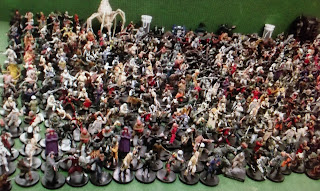
So here is the light at the end of the tunnel I promised. Recently in our never-ending quest for miniatures I bought a huge lot of Star Wars RPG minis off Ebay. We use many minis for home-brewed games all the time, so hundreds of creatures from the Star Wars universe could only help with RPG gameplay. Finally I became curious about the actual rules for the Star Wars PPG itself. I figured we already have all the minis, I may as well track down the rulebook. After some research I decided the book to buy was the Saga Edition Core Rulebook. The books are no longer in print so I had to get them off Ebay. With some digging I got one for not much money at all. When I got it in-hand and started to read it, I was happily surprised.

The Star Wars Saga Edition Core Rulebook by Wizards of The Coast is the most clearly-written rulebook I have come across yet. The book itself is a square and only 286-pages with a 2-sided character sheet and a 2-sided, full color map. The contents are on page 3. A very well-written foreword by Christopher Perkins is on page 5. A simple introduction is on page 7 and then the book does what it should do. First off, it’s not cluttered or printed over a faux background or anything fancy. There are not numerous blocks of multicolored text or anything uselessly distracting like other rulebooks have. It’s just simple black text on white paper. Each section heading is printed in a larger, bold, easy-to-read sci-fi style font—also in black. It’s very easy to read. It’s very easy to understand what each section is going to be about because it's well written too. It’s a very easy book to scan. The margins get slightly fancy with a decorative bar that lists what chapter you are in, page number, and what the chapter is titled. There is also a very simple and convenient color-coding system for each chapter in this margin. It’s decorative and useful. It looks nice but it can also be used to quickly help you scan the book to where you want to be. It’s exactly where it should be too, right where your thumb would go if you wanted to look through the book quickly. This is nice.
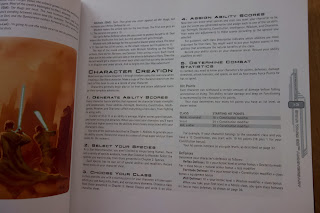
The introduction tells you how to play the game as well as explaining the layout of the book in 9 short pages. This was very nice to see. Chapter 1 has not even started and the entire mechanics of the game have already been explained simply. Anyone who reads those introduction pages will know how to play the game, if they want to try playing the game, and what they need to do, step-by-step, to continue onward. Next in Chapter 1, in three short pages, character abilities are explained. Each ability has its abbreviation listed boldly right next to it in the section heading. Wow! Ability modifiers are explained, as well as how to generate ability scores. The book’s first real table is printed here and it’s listed as Table 1-1: Ability Modifiers. These tables are referenced throughout the book and their exact number heading is used to help you quickly locate them. They are also always printed the same way, in gray with alternating gray and while bars to make them easy to find. Tables in the D&D 4th Edition Players Handbook have no such system. Odd. Same company–different ways of doing things. Huh?

Chapter 2 is for Species. A handy table is listed right up front with all the basic species and their Ability Adjustments. Then all the species are listed in the following pages. No species takes up more then ½ a page. There are a lot of species but you can easily flip through them quickly.

Chapter 3 is for Heroic Classes. We are only on page 35 and already we are having the various classes explained. The D&D 4th Edition Players Handbook is chaptered just like this, just not written as clearly and concisely. In the D&D book, the classes start on page 50 and end on page 175. Then skills start on page 176! In the Star Wars book you are reading about skills on page 57. I know many will say the D&D book has more information. D&D is more complex. D&D is for serious gamers. All of that is nonsense. There is no reason why the D&D book cannot be written as simply and as economically as the Star Wars book.

There is a reason the Star Wars book is written so well. The reason is George Lucas and Lucas Books. Star Wars is not owned by Wizards of the Coast like D&D is. Star Wars is a license that Wizards needs to pay to use. It is expensive to get the Star Wars license for anything. I know. I used to work for a T-shirt company that made Star Wars shirts when Episode 1 came out. You could not just throw together any old design and run off 10 thousand T-shirts, willy-nilly. You had to get everything approved and often times make changes that came from the people at Lucas Licensing. Star Wars is a big deal. They care about Star Wars. Anything that is officially licensed from Star Wars all needs to adhere to a certain level of quality. That level of quality is very high.  Mostly. Sometimes garbage gets through the system, but for the most part Star Wars products are a cut above.

My speculation is that the reason the Star Wars RPG book is the best-written game guide I have yet to come across is because of the people at Lucas Books. I’m sure they did not take anything for granted and made sure that the game mechanics were explained for a person who was brand-spanking new to RPGs. Perhaps even the people at Lucas Books were new to RPGs so they made sure the book was understood by themselves. The result is the finest game guide I own. Say what you will about Star Wars, Jar Jar Binks, and whatever other criticisms you might want to pepper Star Wars with. The Star Wars Saga Edition Core Rulebook is the finest rulebook I own. It’s the high water mark that all other rulebooks should aspire to. I wonder if Wizards even knows what they are sitting on. The D&D Players Handbook is sure not instilling me with confidence that they do in fact know what they have. Further troubling is that the © for the Star Wars book is 2007 and the D&D book is 2008. This means they had already produced this gem before the D&D book. Yikes!
I hope Wizards reads this. I hope they take notice. Use the Star Wars Saga Edition Core Rulebook as a guide for all other rulebooks you might ever produce. It’s gold. It’s Jedi caliber. 

I know it’s not a fluke either, because I have The Force Unleashed Campaign Guide from the same series and it too is laid out and written just as well. I’m now tracking all the books from this series down on Ebay. They are a must-have for any gamer. They also do a great job of explaining the d20 system. Once you read the core rulebook you’ll easily grasp any d20 game.
Lastly, I’d like to write about current Clone Wars action figures by Hasbro. Hasbro is should be noted, owns Wizards of the Coast now. A recent purchase of a random Clone Wars Battle Droid came with a Galactic Battle Card with stats on it and a custom black d6 die with gold symbols on it. A tiny, tiny instruction “manual” also came with it detailing a simple battle game that can be played with Star Wars action figures from this series. The stand has a slot to insert the card into. This is a great little game and a perfect way to get kids into RPG-style battle or strategy games. The card has the d6 symbols on it for the results and there is nothing else to it. Figures, cards, one d6, and an instruction paper the same size as the card. Go grab a few Clone Wars figures and get playing. Customizing this for a home brew RPG with figures you already own would be quite simple, especially if you grab the Star Wars Saga Edition Core Rulebook off Ebay.

–A